mardi 4 octobre 2016

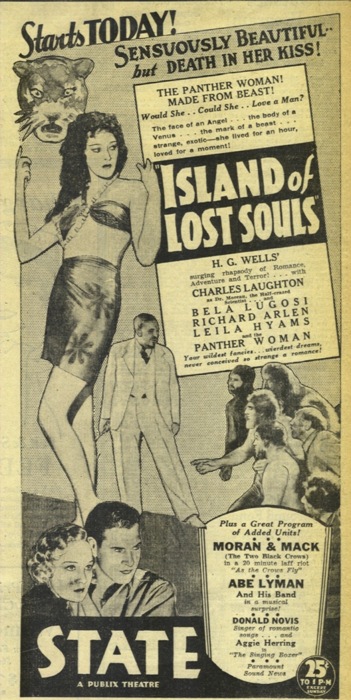
1932 Island of Lost Souls 

( L'Ile du Dr Moreau ) VO Streaming


Island of Lost Souls (1932 film)

From Wikipedia, the free encyclopedia
 
Island of Lost Souls
 
Islandoflostsouls.jpg
Directed by Erle C. Kenton
Written by Philip Wylie
Waldemar Young
Starring Charles Laughton
Richard Arlen
Leila Hyams
Bela Lugosi
Kathleen Burke
Music by Arthur Johnston
Sigmund Krumgold
Cinematography Karl Struss
Distributed by Paramount Pictures
Release dates
  • December 1932
Running time
71 minutes
Country United States
Language English


Island of Lost Souls is an American Pre-Code science fiction horror film starring Charles Laughton, Richard Arlen, Leila Hyams, Bela Lugosi and Kathleen Burke as the Panther Woman, theatrically released in 1933. The film was directed by Erle C. Kenton and produced by Paramount Pictures from a script co-written by science fiction legend Philip Wylie, the movie was the first film adaptation of the H. G. Wells novel The Island of Dr. Moreau, published in 1896. Both book and film are about an obsessed scientist who is secretly conducting surgical experiments on animals on a remote island.

Plot

Shipwrecked traveler Edward Parker (Richard Arlen) is rescued by a freighter delivering animals to an isolated South Seas island owned by Dr. Moreau (Charles Laughton). When Parker objects to the freighter's captain (Stanley Fields) mistreating M'ling (Tetsu Komai), an odd-looking passenger, the captain tosses Parker overboard into Montgomery (Arthur Hohl) and Moreau's boat.
Moreau offers Parker the hospitality of his home and introduces him to Lota (Kathleen Burke), a beautiful, gentle girl who seems a bit simple. When the two hear screams coming from a locked room, which Lota calls the house of pain, Parker investigates. He sees Moreau and Montgomery operating on a person without anesthetic. Convinced that Moreau is engaged in sadistic vivisection, Parker tries to leave, only to encounter brutish-looking men emerging from the jungle. Moreau appears, cracks his whip, and orders the one known as the Sayer of the Law (Bela Lugosi) to repeat the rule against violence. Afterward, the strange men disperse.
Back in the main house, the doctor corrects Parker's mistaken impression. Moreau explains that he started experimenting in London many years previously, accelerating the evolution of plants. He eventually graduated to animals, trying to transform them into people through "plastic surgery, blood transfusions, gland extracts, and ray baths". He would still be working in England on his "bio-anthropological research" if a dog had not escaped from his laboratory and so horrified the people that he was forced to leave.
He reveals that Lota is the sole woman on the island, but hides the fact that she is derived from a panther. Later in private, he expresses his excitement to his assistant, Montgomery, that Lota is becoming more human in her emotions due to her attraction to Parker. To keep Parker around to continue the process, Moreau sees to it that the boat that was to take Parker away is destroyed and places the blame on his beast-men.
As Parker spends time with Lota, she falls in love with him. Eventually the two kiss, but Parker is stricken with guilt, as he has a fiancee, Ruth Thomas (Leila Hyams). When Lota hugs him, Parker feels pain from her three-inch-long claw-like nails. In a fit of rage, he storms into the office of Dr. Moreau and tells him that he considers it criminal to turn panthers into women. Dr. Moreau calmly explains that Lota is his most perfect creation, and he wanted to see if she was capable of falling in love with a man and bearing human-like children. Parker punches Moreau and orders him to make arrangements for him to leave the island as soon as possible. When Moreau discovers that Parker found out about Lota's nature because she is starting to revert to her panther origin, he despairs, believing he has failed – until he notices Lota crying. His hopes are raised and he screams that he will burn out all the animal in her in the house of pain.
In the meantime, the American consul (George Irving) at Apia, Parker's destination, learns where Parker is from the cowed freighter captain. Ruth persuades Captain Donahue (Paul Hurst) to take her to Moreau's island. She is reunited with Parker, but as it is late, Moreau persuades them that it is too dangerous to return immediately to Donahue's ship. They reluctantly agree to stay the night. Ouran, one of Moreau's creations, tries to break into Ruth's room. Fortunately, she wakes up and screams for help. Donahue then offers to try to reach the ship and fetch his crew. Moreau, seeing him depart, dispatches Ouran to strangle him.
This has an unforeseen effect, however. The beast-men no longer feel bound by Moreau's laws, as he has himself broken one of them. Moreau tries to regain control with his whip, but to no avail; in desperation, he demands of them, "What is the law?" But their common response is, "Law no more!!!" With that, they drag the doctor into his house of pain, where they stab him to death with his own surgical instruments.
With help from the fed-up Montgomery, Parker and Ruth make their escape. Parker insists on taking Lota with them. When Lota sees Ouran following, she waits in ambush. In the ensuing struggle, both are killed. The others leave, as the island goes up in flames.

Cast

UK censorship ban

The film was examined and refused a certificate three times by the British Board of Film Censors, in 1933, 1951, and 1957. The reason for the initial ban was due to scenes of vivisection; it is likely that the Cinematograph Films (Animals) Act 1937, which forbade the portrayal of cruelty to animals in feature films released in Britain, was a significant factor in the BBFC's subsequent rejections. The film was eventually passed after cuts were made with an 'X' certificate on July 9, 1958.[1][2] It was later classified as a PG on DVD in 2011 with the cuts reinstated.
Original author H. G. Wells was outspoken in his dislike of the film, feeling the overt horror elements overshadowed the story's deeper philosophical meaning.
The censors also objected to Dr. Moreau saying "Do you know what it means to feel like God?"




1931 The Black Camel VO Streaming

1931 The Black Camel VO Streaming


The Black Camel (film)

From Wikipedia, the free encyclopedia
 
 
The Black Camel
Poster of The Black Camel (film).jpg
Directed by Hamilton MacFadden
Produced by Hamilton MacFadden
Written by Earl Derr Biggers (novel)
Hugh Stanislaus Stange (adaptation)
Screenplay by Barry Conners
Philip Klein
Dudley Nichols (uncredited)
Starring Warner Oland
Sally Eilers
Bela Lugosi
Dorothy Revier
Cinematography Joseph August
Daniel Clark
Edited by Alde Gaetano
Production
company
Fox Film Corporation
Hamilton MacFadden
Distributed by Fox Film Corporation
Release dates
  • June 21, 1931
Running time
67 or 71 minutes
Country United States
Language English


The Black Camel is a 1931 American Pre-Code mystery film based on the novel of the same name by Earl Derr Biggers.[1] It is the second film to star Warner Oland as detective Charlie Chan, and the sole survivor of the first five Chan films starring Oland. The Black Camel marked the film debut of Robert Young.

Plot

Movie star Shelah Fayne is making a picture on location in Honolulu, Hawaii. She summons mystic adviser Tarneverro from Hollywood to help her decide whether to marry wealthy Alan Jaynes, a man she has only known for a week. Her friend Julie O'Neil worries, however, that the famous psychic has too much influence over her. Meanwhile, Julie has fallen in love herself with local publicity director Jimmy Bradshaw.
Honolulu Police Inspector Chan pretends to be a humble merchant, but Tarneverro sees through his impersonation. Chan mentions to him the yet unsolved murder of film star Denny Mayo, committed years before.
Then Jimmy finds Shelah's body; she has been murdered. Julie makes him remove Shelah's ring before calling for the police.
Chan investigates. He invites Tarneverro to assist him. Tarneverro reveals that Shelah told him she was in love with Denny and was responsible for his death, but kept quiet to protect her career.
The suspects are many, but after various startling revelations, Chan eventually identifies the killer and the connection to Mayo's death.

Cast (in credits order)

Other

The film further reunited Lugosi with Dwight Frye (playing Jessup, the butler), who had appeared with him in Dracula in the same year. C. Henry Gordon, who had been in Warner Oland's first (lost) Chan film and would show up in three more Chan films with both Oland and the later Chan Sidney Toler, appears uncredited as Huntley Van Horn.[citation needed]
Much of the picture was shot on location in Honolulu, with several scenes filmed at the renowned Royal Hawaiian Hotel.


1931 Never The Twain Shall Meet VO Streaming


Never the Twain Shall Meet (1931 film)

From Wikipedia, the free encyclopedia
Never the Twain Shall Meet
Directed by W. S. Van Dyke
Produced by Louis B. Mayer
Irving Thalberg
Written by Peter B. Kyne (novel: Never the Twain Shall Meet)
Edwin Justus Mayer (adaptation)
Ruth Cummings (dialogue)
John Lynch (dialogue)
Starring Leslie Howard
Conchita Montenegro
C. Aubrey Smith
Cinematography Merritt B. Gerstad
Edited by Ben Lewis (editor)
Distributed by Metro-Goldwyn-Mayer
Release dates
May 16, 1931
Running time
8 reels
Country United States
Language English


Never the Twain Shall Meet is a 1931 talking film produced and distributed by Metro-Goldwyn-Mayer and starring Leslie Howard and Conchita Montenegro. It is based on the book by Peter B. Kyne. The film was directed by W. S. Van Dyke and was filmed in Tahiti like Van Dyke's two previous south sea adventures The Pagan and White Shadows in the South Seas. The film is a remake of a 1925 silent film of the same name.[1][2]

Plot

The film centers around Dan Pritchard (Leslie Howard) who is a partner along with his father, played by C. Aubrey Smith, in a San Francisco-based shipping company and who has been in an extended engagement with socialite Maisie Morrison, played by Karen Morley. Dan is called to the ship of his father's friend, Capt. Larrieau, played by Mitchell Lewis, who informs him he has contracted leprosy and needs someone to look after his daughter, Tamea, whose mother was a Polynesian queen. Tamea, who is played by Conchita Montenegro, is a barefoot native girl, skimpily dressed, her hair wild and her aspect wilder. Pritchard and Tamea seem to be taken by each other from the start. Once Pritchard agrees to care for and educate Tamea and see to it that she marries respectably, her father unexpectedly goes topside and kills himself.
Over the next few days, Dan can't help becoming infatuated with Tamea who constantly throws herself at him. She seems to have grown up with no filters or concept of personal space and proceeds to maul Dan who is shocked and surprised by her behavior but can't seem to control her. While attending a party, Dan is put off by his friends' prejudice and his affections transfer from his fiancé to Tamea, who then seduces him. Dan's father, afraid that his son is losing control, puts Tamea on the next boat back to the Islands. Dan soon follows.
The two live together happily at first, although it is evident from the start that Dan feels out of his element in the tropics with nothing to do but lay about all day and drink in the local bar. Things start to go terribly wrong when Dan realizes that because Tamea has none of the sexual repressions of his Western world she is a bit too free with one of the barely dressed native Island boys, Tolongo (Bob Gilbert), and Dan becomes jealous of her attentions towards him. The enchantment has worn off and Dan proceeds to become an angry drunk.
Fortunately for Dan, his fiancé Maisie did not give up on him when he deserted her and she follows him to the Island, rescuing him from the tropical paradise which has become his nightmare. Although Tamea is sad about Dan's departure, she immediately takes up with her bare chested native boyfriend to help her forget.

Cast

Production

Woody Van Dyke, who directed the film, is better known for his work on Tarzan the Ape Man (1932) starring Johnny Weissmuller, The Thin Man (1934) with William Powell and Myrna Loy, and San Francisco (1936) starring Clark Gable and Spencer Tracy, receiving Oscar nominations for the latter two movies. Van Dyke was known as "One Take Woody" because he brought his films to completion on time and under budget. He directed four actors (William Powell, Spencer Tracy, Norma Shearer and Robert Morley) in their Oscar nominated performances.
In 1931, Howard was new to Hollywood, having only appeared in two films, Outward Bound (1930) and Devotion (1931). In the spring of 1931, Howard was filming Never the Twain Shall Meet, A Free Soul with Norma Shearer and Clark Gable, and Five and Ten with Marion Davies—shooting one movie in the morning and another in the afternoon.[3] This led to Howard's lifelong distaste for film acting, the studio system, contracts and the typical schedules required of a Hollywood actor. Howard said that a "typical 'talkie'...is manufactured on the conveyor-belt system" and that the script is "handed to the actor anywhere from a few days to a few hours before he reports for work...The cast is not even gathered together to read the script before it goes into production."[4] Add into the mix a director who gets the scene in one take and it is not hard to understand Howard's frustration. It is obvious why Howard would return to the theater over and over again during his career.
It was long rumored that Conchita Montenegro, the sexy barely 18 year old Spanish actress who played Howard's love interest in the film, and Howard had a brief affair either during filming or shortly thereafter. Spanish author José Rey Ximena refers to an affair in his book, El Vuolo de Ibis [The Flight of the Ibis],[5] however the book has never been translated into English. It is clear that Howard and Montenegro were fond of each other as evidenced by photos taken of the two in Madrid, Spain, in May, 1943, shortly before Howard's death. Rey Ximena's book also discusses the claim by Montenegro that she facilitated a meeting between Howard and Francisco Franco at the request of Winston Churchill to convince Franco not to enter WWII on the side of the Axis powers.
Norma Shearer's brother, Douglas Shearer, served as Sound Director. Shearer, who came up with a recording system that eliminated background noise, was a pioneer in sound technology and during his career received seven Academy Awards, with many more nominations. Shearer's credits include every notable MGM film made between the years 1930 to 1953. He won an additional seven technical Academy Awards during his time as MGM's Director of Technical Research (1955 to 1968).
Arthur Freed whose works include "Singin' in the Rain," "You Were Meant for Me," "All I Do Is Dream of You" and "You Are My Lucky Star," wrote the theme song, "Islands of Love."

Reception

Although Never the Twain Shall Meet is not considered to be one of Leslie Howard's finest films, he did receive a positive review in The New York Times in which was stated "Mr. Howard comes through with another of his specimens of finished acting, investing his character with humor and personality" and that the movie was worth seeing.[6]
According to the file in the Motion Picture Association of America Production Code Administration Records (MPAA/PCA) Collection at the AMPAS Library, the film was only approved by the Hays office because MGM's treatment of the picture was "all right from the point of view of miscegenation because the father of the girl is white and he is the only one shown in the picture. The mother was a Polynesian queen and Polynesians are not black."[7] Hays office official, John V. Wilson, also stated that "it might be dangerous to have the son (Leslie Howard) already married and that it would be better to retain the idea in the original story that he has been engaged to the girl a long time and is just on the point of marrying her...If in the beginning of the picture a great deal of audience sympathy is created for the situation surrounding the son and if in the end of the picture the audience is made to feel with him the fallacy of his action is deserting his former life, the tone of the picture will be kept at a level sufficient to satisfy the standards of the Code."


lundi 15 août 2016

C'était au temps où Tahiti riait VF Streaming


C'était au Temps où Tahiti Riait ...
...en s'appuyant sur des images d'archives datante des Années 70
toujours émouvantes pour les amoureux de TAHiTi
un regard très "rétro" .

trouvé sur Youtube uploadé par Alain René de Nilperthuis

1953 Si Tahiti m'était conté VF Streaming


Telecharger la Video

  1950 - 1960 Les Films Gaston Guilbert

@ CinemaTamua Tahiti Films

Streaming