Affichage des articles dont le libellé est 1932. Afficher tous les articles

mardi 4 octobre 2016

1932 Island of Lost Souls 

( L'Ile du Dr Moreau ) VO Streaming


Island of Lost Souls (1932 film)

From Wikipedia, the free encyclopedia
 
Island of Lost Souls
 
Islandoflostsouls.jpg
Directed by Erle C. Kenton
Written by Philip Wylie
Waldemar Young
Starring Charles Laughton
Richard Arlen
Leila Hyams
Bela Lugosi
Kathleen Burke
Music by Arthur Johnston
Sigmund Krumgold
Cinematography Karl Struss
Distributed by Paramount Pictures
Release dates
  • December 1932
Running time
71 minutes
Country United States
Language English


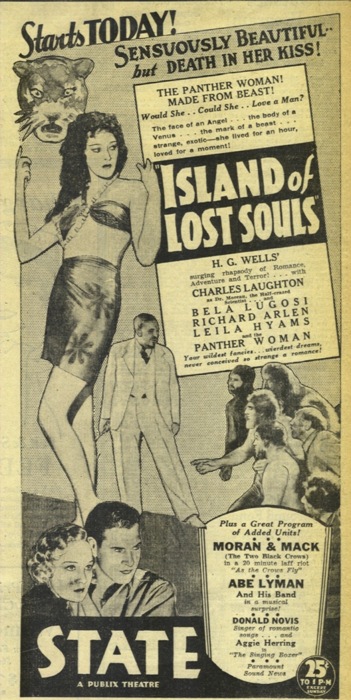
Island of Lost Souls is an American Pre-Code science fiction horror film starring Charles Laughton, Richard Arlen, Leila Hyams, Bela Lugosi and Kathleen Burke as the Panther Woman, theatrically released in 1933. The film was directed by Erle C. Kenton and produced by Paramount Pictures from a script co-written by science fiction legend Philip Wylie, the movie was the first film adaptation of the H. G. Wells novel The Island of Dr. Moreau, published in 1896. Both book and film are about an obsessed scientist who is secretly conducting surgical experiments on animals on a remote island.

Plot

Shipwrecked traveler Edward Parker (Richard Arlen) is rescued by a freighter delivering animals to an isolated South Seas island owned by Dr. Moreau (Charles Laughton). When Parker objects to the freighter's captain (Stanley Fields) mistreating M'ling (Tetsu Komai), an odd-looking passenger, the captain tosses Parker overboard into Montgomery (Arthur Hohl) and Moreau's boat.
Moreau offers Parker the hospitality of his home and introduces him to Lota (Kathleen Burke), a beautiful, gentle girl who seems a bit simple. When the two hear screams coming from a locked room, which Lota calls the house of pain, Parker investigates. He sees Moreau and Montgomery operating on a person without anesthetic. Convinced that Moreau is engaged in sadistic vivisection, Parker tries to leave, only to encounter brutish-looking men emerging from the jungle. Moreau appears, cracks his whip, and orders the one known as the Sayer of the Law (Bela Lugosi) to repeat the rule against violence. Afterward, the strange men disperse.
Back in the main house, the doctor corrects Parker's mistaken impression. Moreau explains that he started experimenting in London many years previously, accelerating the evolution of plants. He eventually graduated to animals, trying to transform them into people through "plastic surgery, blood transfusions, gland extracts, and ray baths". He would still be working in England on his "bio-anthropological research" if a dog had not escaped from his laboratory and so horrified the people that he was forced to leave.
He reveals that Lota is the sole woman on the island, but hides the fact that she is derived from a panther. Later in private, he expresses his excitement to his assistant, Montgomery, that Lota is becoming more human in her emotions due to her attraction to Parker. To keep Parker around to continue the process, Moreau sees to it that the boat that was to take Parker away is destroyed and places the blame on his beast-men.
As Parker spends time with Lota, she falls in love with him. Eventually the two kiss, but Parker is stricken with guilt, as he has a fiancee, Ruth Thomas (Leila Hyams). When Lota hugs him, Parker feels pain from her three-inch-long claw-like nails. In a fit of rage, he storms into the office of Dr. Moreau and tells him that he considers it criminal to turn panthers into women. Dr. Moreau calmly explains that Lota is his most perfect creation, and he wanted to see if she was capable of falling in love with a man and bearing human-like children. Parker punches Moreau and orders him to make arrangements for him to leave the island as soon as possible. When Moreau discovers that Parker found out about Lota's nature because she is starting to revert to her panther origin, he despairs, believing he has failed – until he notices Lota crying. His hopes are raised and he screams that he will burn out all the animal in her in the house of pain.
In the meantime, the American consul (George Irving) at Apia, Parker's destination, learns where Parker is from the cowed freighter captain. Ruth persuades Captain Donahue (Paul Hurst) to take her to Moreau's island. She is reunited with Parker, but as it is late, Moreau persuades them that it is too dangerous to return immediately to Donahue's ship. They reluctantly agree to stay the night. Ouran, one of Moreau's creations, tries to break into Ruth's room. Fortunately, she wakes up and screams for help. Donahue then offers to try to reach the ship and fetch his crew. Moreau, seeing him depart, dispatches Ouran to strangle him.
This has an unforeseen effect, however. The beast-men no longer feel bound by Moreau's laws, as he has himself broken one of them. Moreau tries to regain control with his whip, but to no avail; in desperation, he demands of them, "What is the law?" But their common response is, "Law no more!!!" With that, they drag the doctor into his house of pain, where they stab him to death with his own surgical instruments.
With help from the fed-up Montgomery, Parker and Ruth make their escape. Parker insists on taking Lota with them. When Lota sees Ouran following, she waits in ambush. In the ensuing struggle, both are killed. The others leave, as the island goes up in flames.

Cast

UK censorship ban

The film was examined and refused a certificate three times by the British Board of Film Censors, in 1933, 1951, and 1957. The reason for the initial ban was due to scenes of vivisection; it is likely that the Cinematograph Films (Animals) Act 1937, which forbade the portrayal of cruelty to animals in feature films released in Britain, was a significant factor in the BBFC's subsequent rejections. The film was eventually passed after cuts were made with an 'X' certificate on July 9, 1958.[1][2] It was later classified as a PG on DVD in 2011 with the cuts reinstated.
Original author H. G. Wells was outspoken in his dislike of the film, feeling the overt horror elements overshadowed the story's deeper philosophical meaning.
The censors also objected to Dr. Moreau saying "Do you know what it means to feel like God?"




samedi 9 juillet 2016

1932 Rain VO Streaming

Rain (1932 film)

From Wikipedia, the free encyclopedia
Rain
Rain 1932 film.jpg
theatrical film poster
Directed by Lewis Milestone (uncredited)
Produced by Lewis Milestone
Written by W. Somerset Maugham (story)
Maxwell Anderson (adaptation)
Based on Rain (play) by John Colton
and Clemence Randolph
Starring Joan Crawford
Music by Alfred Newman
Cinematography Oliver T. Marsh
Edited by W. Duncan Mansfield
Distributed by United Artists
Release dates
  • October 12, 1932
Running time
92 minutes
Country United States
Language English
Budget $591,000

Rain is a 1932 South Seas drama film directed by Lewis Milestone with portions filmed at Santa Catalina Island, California. The film stars Joan Crawford as prostitute Sadie Thompson and features Walter Huston as a conflicted missionary who wants to reform Sadie, but whose own morals start decaying. Crawford was loaned out by MGM to United Artists for this film.
The plot of the film is based on the 1923 play Rain by John Colton and Clemence Randolph, which in turn was based on the short story "Miss Thompson" (later retitled "Rain") by W. Somerset Maugham. Actress Jeanne Eagels had played the role on stage. Other movie versions of the story include: a 1928 silent film titled Sadie Thompson starring Gloria Swanson, and the heavily sanitized Miss Sadie Thompson (1953), which starred Rita Hayworth.
In 1960, the film entered the public domain in the USA due to the copyright claimants failure to renew the copyright registration in the 28th year after publication.[1]

Plot


Joan Crawford as Sadie
A westbound ship en route to Apia, Samoa, is temporarily stranded at nearby Pago Pago due to a possible cholera outbreak on board. Among the passengers are Alfred Davidson, a self-righteous missionary, his wife, and Sadie Thompson, a prostitute. Thompson passes the time partying and drinking with the American Marines stationed on the island. Sergeant Tim O'Hara, nicknamed by Sadie as "Handsome", falls in love with her.
Her wild behavior soon becomes more than the Davidsons can stand and Mr. Davidson confronts Sadie, resolving to save her soul. When she dismisses his offer, Davidson has the Governor order her deported to San Francisco, California, where she is wanted for an unspecified crime (for which she says she was framed). She begs Davidson to allow her to remain on the island a few more days – her plan is to flee to Sydney, Australia. During a heated argument with Davidson, she experiences a religious conversion and agrees to return to San Francisco and the jail sentence awaiting her there.
The evening before she is to leave, Sergeant O'Hara asks Sadie to marry him and offers to hide her until the Sydney boat sails, but she refuses. Later, while native drums beat, the repressed Davidson satisfies his lust with Sadie. The next morning he is found dead on the beach – a suicide. Davidson's hypocrisy and betrayal cause Thompson to return to her old self and she goes off to Sydney with O'Hara to start a new life.

Cast

Reception

Rain was not well received – either critically or financially – upon initial release. The unglamorous role for Crawford, and bold story (religious hypocrisy being its main theme), caught Depression-era audiences off guard.
Motion Picture Herald commented, "Because the producers have made such a strong attempt to establish the stern impressiveness of the story, it is rather slow. In its drive to become powerful, it appears to have lost the spark of spontaneity....Joan Crawford and Walter Huston are satisfactory."
Variety noted, "It turns out to be a mistake to have assigned the Sadie Thompson role to Miss Crawford. It shows her off unfavorably. The dramatic significance of it all is beyond her range.... [Director] Milestone tried to achieve action with the camera, but wears the witnesses down with words. Joan Crawford's get-up as the light lady is extremely bizarre. Pavement pounders don't quite trick themselves up as fantastically as all that. In commercial favor of Rain is the general repute of the theme and Miss Crawford's personal following, but the finished product will not help either."

Box Office

The film earned $538,000 in the US and Canada and $166,000 elsewhere, resulting in a loss of $198,000.


1932 Bird of Paradise VO Streaming

Bird of Paradise is a 1951 drama film directed by Delmer Daves. It stars Debra Paget and Louis Jourdan.[3]


Bird of paradise English Poster.jpg

Directed by Delmer Daves
Produced by Delmer Daves
Screenplay by Delmer Daves
Based on the play
by Richard Walton Tully
Starring Debra Paget
Louis Jourdan
Jeff Chandler
Music by Daniele Amfitheatrof
Cinematography Winton C. Hoch
Edited by James B. Clark
Distributed by 20th Century Fox
Release dates
  • March 14, 1951 (United States)
Running time
100 minutes
Country United States
Language English
Box office $1,650,000 (US r

Plot

Andre Laurence (Jourdan) takes a trip to a Polynesian island with his college roommate Tenga (Chandler). He assumes the native life and marries his friend's sister, Kalua. An eruption of a volcano and the Kahuna, the island's shaman, decides that the volcano can be appeased with the sacrifice of Kalua.

Cast

O'ahu native Queenie Ventura (married name Dowsett), born 1930, half pure Hawaiian and half Portuguese, joined the cast as a featured dancer and the local lead actress.

Production

The movie was announced in May 1950.[4] It reunited several personnel from Broken Arrow including Deborah Paget, Delmer Daves and Jeff Chandler. Chandler joked that his character was a variation on his performance as Cochise in Broken Arrow.
The story is really about a conflict of worlds in 1850: a primitive people who live by their beliefs and the civilisation - in quotes - brought by the white man. The problem is never resolved; even marriage can't do it - but... we used some wonderful locations and the scenery is breathtakingly beautiful.[5]
Sterling Hayden was mentioned as a possibility for the male lead.[6] Eventually Louis Jourdan was cast. Delmer Daves claims he wrote "a practically new story" from the play.[7] It was Maurice Schwartz's second movie role.[8]
The film was shot on location in Hawaii starting in August 1950.[9] Key locations were Hanalei Bay, Waikiki, Kona Coast and Volcano.[10]
Chandler had to be flown back every weekend to Los Angeles in order to fulfill his radio commitment to Our Miss Brooks.[5]

Reception

Critical response

When the film was released, The New York Times film critic Bosley Crowther panned the film, writing, "There is certainly nothing original—or particularly blissful, we would say—about the romantic tumble here taken by a visiting white man for a beauteous native maid...Unfortunately, Delmer Daves, who directed and wrote the script, either didn't or wasn't permitted to pitch the whole film in this slyly kidding vein. And the consequence is a rambling mishmosh of South Sea romance and travesty, of solemn high-priesting and low clowning, of never-never spectacle and sport."[11]
On the other hand, the staff at Variety magazine gave the film a favorable review, writing, "Richard Walton Tully's old legit piece, Bird of Paradise, makes another trip to the screen in a refurbished version. Previous filming of the play was in 1932 and, while Delmer Daves' version deviates from the Tully form, the essentials of the drama are still there, plus a beautiful Technicolor camera job, haunting island music and the use of actual locales...Paget hits a high level in her performance as the Princess Kalua. She, as well as the other players give their characters considerable sincerity. Jourdan is an excellent choice as the island visitor, as is Chandler as the prince."[12]