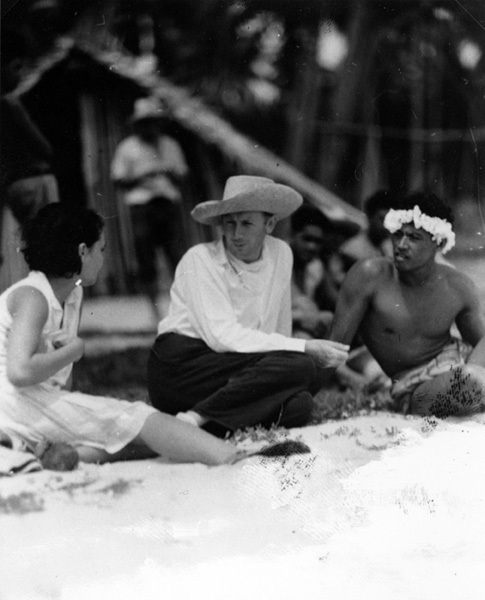
1931 Never The Twain Shall Meet VO Streaming
Never the Twain Shall Meet (1931 film)
From Wikipedia, the free encyclopedia
Never the Twain Shall Meet is a 1931 talking film produced and distributed by
Metro-Goldwyn-Mayer and starring
Leslie Howard and
Conchita Montenegro. It is based on the book by
Peter B. Kyne. The film was directed by
W. S. Van Dyke and was filmed in Tahiti like Van Dyke's two previous south sea adventures
The Pagan and
White Shadows in the South Seas. The film is a remake of a 1925 silent film of the
same name.
[1][2]
Plot
The film centers around Dan Pritchard (
Leslie Howard) who is a partner along with his father, played by
C. Aubrey Smith,
in a San Francisco-based shipping company and who has been in an
extended engagement with socialite Maisie Morrison, played by
Karen Morley. Dan is called to the ship of his father's friend, Capt. Larrieau, played by
Mitchell Lewis,
who informs him he has contracted leprosy and needs someone to look
after his daughter, Tamea, whose mother was a Polynesian queen. Tamea,
who is played by
Conchita Montenegro,
is a barefoot native girl, skimpily dressed, her hair wild and her
aspect wilder. Pritchard and Tamea seem to be taken by each other from
the start. Once Pritchard agrees to care for and educate Tamea and see
to it that she marries respectably, her father unexpectedly goes topside
and kills himself.
Over the next few days, Dan can't help becoming infatuated with Tamea
who constantly throws herself at him. She seems to have grown up with
no filters or concept of personal space and proceeds to maul Dan who is
shocked and surprised by her behavior but can't seem to control her.
While attending a party, Dan is put off by his friends' prejudice and
his affections transfer from his fiancé to Tamea, who then seduces him.
Dan's father, afraid that his son is losing control, puts Tamea on the
next boat back to the Islands. Dan soon follows.
The two live together happily at first, although it is evident from
the start that Dan feels out of his element in the tropics with nothing
to do but lay about all day and drink in the local bar. Things start to
go terribly wrong when Dan realizes that because Tamea has none of the
sexual repressions of his Western world she is a bit too free with one
of the barely dressed native Island boys, Tolongo (Bob Gilbert), and Dan
becomes jealous of her attentions towards him. The enchantment has worn
off and Dan proceeds to become an angry drunk.
Fortunately for Dan, his fiancé Maisie did not give up on him when he
deserted her and she follows him to the Island, rescuing him from the
tropical paradise which has become his nightmare. Although Tamea is sad
about Dan's departure, she immediately takes up with her bare chested
native boyfriend to help her forget.
Cast
Production
Woody Van Dyke, who directed the film, is better known for his work on
Tarzan the Ape Man (1932) starring
Johnny Weissmuller,
The Thin Man (1934) with
William Powell and
Myrna Loy, and
San Francisco (1936) starring
Clark Gable and
Spencer Tracy, receiving Oscar nominations for the latter two movies.
Van Dyke was known as "One Take Woody" because he brought his films to completion on time and under budget. He directed four actors (
William Powell,
Spencer Tracy,
Norma Shearer and
Robert Morley) in their Oscar nominated performances.
In 1931,
Howard was new to Hollywood, having only appeared in two films,
Outward Bound (1930) and
Devotion (1931). In the spring of 1931,
Howard was filming
Never the Twain Shall Meet,
A Free Soul with
Norma Shearer and
Clark Gable, and
Five and Ten with
Marion Davies—shooting one movie in the morning and another in the afternoon.
[3] This led to
Howard's lifelong distaste for film acting, the
studio system, contracts and the typical schedules required of a Hollywood actor.
Howard
said that a "typical 'talkie'...is manufactured on the conveyor-belt
system" and that the script is "handed to the actor anywhere from a few
days to a few hours before he reports for work...The cast is not even
gathered together to read the script before it goes into production."
[4] Add into the mix a director who gets the scene in one take and it is not hard to understand
Howard's frustration. It is obvious why
Howard would return to the theater over and over again during his career.
It was long rumored that
Conchita Montenegro, the sexy barely 18 year old Spanish actress who played
Howard's love interest in the film, and
Howard
had a brief affair either during filming or shortly thereafter. Spanish
author José Rey Ximena refers to an affair in his book,
El Vuolo de Ibis [The Flight of the Ibis],
[5] however the book has never been translated into English. It is clear that
Howard and
Montenegro were fond of each other as evidenced by photos taken of the two in Madrid, Spain, in May, 1943, shortly before
Howard's death. Rey Ximena's book also discusses the claim by
Montenegro that she facilitated a meeting between
Howard and
Francisco Franco at the request of
Winston Churchill to convince
Franco not to enter
WWII on the side of the
Axis powers.
Norma Shearer's brother,
Douglas Shearer, served as Sound Director.
Shearer,
who came up with a recording system that eliminated background noise,
was a pioneer in sound technology and during his career received seven
Academy Awards, with many more nominations.
Shearer's credits include every notable
MGM film made between the years 1930 to 1953. He won an additional seven
technical Academy Awards during his time as
MGM's Director of Technical Research (1955 to 1968).
Arthur Freed whose works include "
Singin' in the Rain," "
You Were Meant for Me," "
All I Do Is Dream of You" and "You Are My Lucky Star," wrote the theme song, "Islands of Love."
Reception
Although
Never the Twain Shall Meet is not considered to be one of
Leslie Howard's finest films, he did receive a positive review in
The New York Times in which was stated "Mr.
Howard
comes through with another of his specimens of finished acting,
investing his character with humor and personality" and that the movie
was worth seeing.
[6]
According to the file in the
Motion Picture Association of America Production Code Administration Records (MPAA/PCA) Collection at the
AMPAS Library, the film was only approved by the
Hays office because
MGM's treatment of the picture was "all right from the point of view of
miscegenation
because the father of the girl is white and he is the only one shown in
the picture. The mother was a Polynesian queen and Polynesians are not
black."
[7] Hays office official, John V. Wilson, also stated that "it might be dangerous to have the son (
Leslie Howard)
already married and that it would be better to retain the idea in the
original story that he has been engaged to the girl a long time and is
just on the point of marrying her...If in the beginning of the picture a
great deal of audience sympathy is created for the situation
surrounding the son and if in the end of the picture the audience is
made to feel with him the fallacy of his action is deserting his former
life, the tone of the picture will be kept at a level sufficient to
satisfy the standards of the Code."