1990 The Rescuers Down Under VO Streaming
The Rescuers Down Under
From Wikipedia, the free encyclopedia
|
|---|
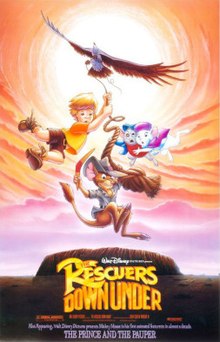
|
| Directed by |
|
| Produced by |
Thomas Schumacher |
| Screenplay by |
|
| Starring |
|
| Music by |
Bruce Broughton |
| Edited by |
Michael Kelly |
Production
company
|
|
| Distributed by |
Buena Vista Pictures |
Release dates
|
|
Running time
|
77 minutes |
| Country |
United States |
| Language |
English |
| Budget |
$37,931,000 |
| Box office |
$47.4 million[1] |
The Rescuers Down Under is a 1990 American
animated adventure film produced by
Walt Disney Feature Animation and released by
Walt Disney Pictures on November 16, 1990. The 29th film in the
Walt Disney Animated Classics series, the film is the sequel to the 1977 animated film
The Rescuers, which was based on the novels of
Margery Sharp. Set in the
Australian Outback,
the film centers on Bernard and Bianca traveling to Australia to save a
boy named Cody from a bloodthirsty poacher in pursuit of an endangered
bird of prey.
Featuring the voices of
Bob Newhart,
Eva Gabor (in her final film role),
John Candy, and
George C. Scott,
The Rescuers Down Under was the first animated theatrical film sequel produced by Disney;
[2] along with
Fantasia 2000, and
Winnie the Pooh (2011), it is one of the few sequels that are part of the
Disney animated features canon. The film was the second released during the
Disney Renaissance (1989–1999) era, which had begun the year prior with
The Little Mermaid, but was a major under-performer at the box-office compared to
Mermaid and the other films of the Disney Renaissance era.
Plot
In the
Australian Outback, a young boy named Cody rescues and befriends a rare
giant eagle named Marahute, who shows him her nest and eggs. Later on,
the boy unknowingly falls into an animal trap set by Percival C.
McLeach, a local
poacher wanted by the
Australian Rangers.
When McLeach finds one of the eagle's feathers on the boy's backpack,
he is instantly overcome with excitement, for he knows that catching an
eagle that size would make him rich because he had caught one before,
which was Marahute's mate. McLeach throws Cody's backpack to a pack of
crocodiles in order to trick the Rangers into thinking that Cody was
dead, and kidnaps him in his attempt to force him to reveal the
whereabouts of Marahute.
A mouse, the bait in the trap, runs off to alert the Rescue Aid Society. A
telegram
is sent to the Rescue Aid Society headquarters in New York City, where
Bernard and Miss Bianca, the RAS' elite field agents, are assigned to
the mission, despite Bernard's attempts to propose marriage to Bianca.
They go to find Orville the
albatross
who aided them previously, but instead find his brother Wilbur. Bernard
and Bianca convince Wilbur to fly them to Australia to save Cody. In
Australia, they meet Jake, a
hopping mouse
who is the RAS' local regional operative. Jake becomes infatuated with
Bianca and starts flirting with her, despite Bernard's chagrin. He
serves as their "tour guide" and protector in search of the missing boy.
At the same time, Wilbur is immobilized when his
spinal column
is bent out of its natural shape, convincing Jake to send him to a
nearby hospital run by mice. Wilbur, terrified of the surgical equipment
the doctor intends to use (including a chainsaw), refuses to undergo
surgery and is forced to flee. His back is unintentionally straightened
by the efforts of the mouse medical staff preventing him from escaping
through a window. Cured, Wilbur departs in search of his friends. At
McLeach's ranch, Cody has been thrown into the dungeon with several of
McLeach's imprisoned animals for refusing to give up Marahute's
whereabouts. Cody tries to free himself and the animals using various
objects tied together with a hook on the end, but he is thwarted every
time by Joanna, McLeach's pet
goanna.
Realizing that Marahute's eggs are Cody's weak spot, McLeach tricks
Cody into thinking that Marahute has died, causing Cody to lead him
straight to Marahute's nest.
Bernard, Bianca, and Jake, knowing that Cody is about to fall for a trap, jump onto McLeach's
Halftrack
to follow him. At Marahute's nest, the three mice try to warn Cody that
he has been followed; for just as they do, McLeach arrives and captures
Marahute, along with Cody, Jake, and Bianca. Following McLeach's
orders, Joanna tries to eat Marahute's eggs, but realizes they are
actually egg-shaped rocks. Frightened that McLeach might be angry with
her, Joanna drops the stones over the cliff instead. When she leaves,
Bernard crawls out of the nest with the hidden eggs, grateful that
Joanna fell for the trick. Just then, Wilbur arrives at the nest,
whereupon Bernard convinces him to sit on the eagle's
eggs,
so that Bernard can go after McLeach. Enraged by Cody's interference,
McLeach takes his captives to Crocodile Falls, where he ties Cody up and
hangs him over a group of crocodiles in attempts to feed him to them.
But Bernard, riding a wild
razorback pig he had tamed using a
horse whispering technique that Jake used on a snake earlier, follows and disables McLeach's vehicle.
McLeach then tries to shoot the rope holding Cody above the water. To
save Cody, Bernard tricks Joanna into crashing into McLeach, causing
them to both fall into the water. This causes the crocodiles to turn
their attention from Cody toward McLeach and Joanna, while behind them
the badly damaged rope holding Cody breaks apart. McLeach fights and
fends off the crocodiles, but although Joanna manages to reach the
shoreline, McLeach is swept over the waterfall to his death. Bernard
dives into the water to save Cody, but every time he fails. His actions,
however, buy Jake and Bianca enough time to free Marahute so they can
save both Cody and Bernard.
Bernard, desperate to prevent any further incidents, proposes to
Bianca, who eagerly and happily accepts while Jake salutes him with a
newfound respect. All of them depart for Cody's home. Back at the nest,
Marahute's eggs finally hatch, much to Wilbur's dismay.
Cast
The Rescuers Down Under
features three characters from the first film: Bernard, Bianca, and the
Chairmouse, all of whom feature the same actors reprising their roles
from the
original 1977 Rescuers film.
- Bob Newhart
as Bernard, a male grey mouse; the United States representative of the
Rescue Aid Society, promoted from his role as janitor to full-fledged
agent after proving a success with the previous rescue.
- Eva Gabor
as Miss Bianca, a female white mouse; the Hungarian representative of
the Rescue Aid Society. This was Eva Gabor's last film role before her
death in 1995.
- John Candy as Wilbur, a comical albatross; named after Wilbur Wright. He is the brother of Orville, the albatross who appeared in the first film (named after Orville Wright).
- Adam Ryen as Cody, a young boy able to converse with most animals, the same as Penny in the first film.
- George C. Scott as Percival C. McLeach, a sinister poacher who wants to capture Marahute for money.
- Frank Welker
as Marahute, a giant Haast's Eagle, also played additional special
vocal effects and Joanna, McLeach's pet goanna who enjoys intimidating
her captives and has a fondness for eggs.
- Tristan Rogers as Jake, a debonair, self-confident and charismatic kangaroo mouse.
- Peter Firth as Red, a male red kangaroo imprisoned by McLeach.
- Wayne Robson as Frank, an erratic frill-necked lizard imprisoned by McLeach.
- Douglas Seale as Krebbs, a koala imprisoned by McLeach.
- Carla Meyer as Faloo, a female red kangaroo who summons Cody to save Marahute. Meyer also voices Cody's mother.
- Bernard Fox
as Chairmouse, the chairman of the Rescue Aid Society. Fox also voices
Doctor Mouse, the supervisor of the surgical mice who examine Wilbur
when he is injured.
- Russi Taylor as Nurse Mouse, the operator of Doctor Mouse's instructions and a competent second-in-command.
Production
Development
Writing for
The Rescuers Down Under began in 1986.
[3] Following work on
Oliver & Company,
Peter Schneider, vice president of Walt Disney Feature Animation, asked supervising animator
Mike Gabriel if he would consider directing. At the time, Gabriel declined the offer, stating "Well, after watching
George [Scribner], it doesn't look like it would be much fun." After a few months, Schneider offered Gabriel to direct
Rescuers Down Under, which he accepted.
[4] Following his assignment as supervising animator as Tito on
Oliver, which was met with favorable praise from general audiences, Hendel Butoy was added to co-direct
Rescuers Down Under with Gabriel.
[5] Meanwhile, Schneider recruited
Thomas Schumacher, who had worked at the
Mark Taper Forum, to serve as producer on the project.
[6] With Schumacher as producer, he selected storyboard artist
Joe Ranft
to serve as story supervisor because of his "ability to change and
transform through excellence of idea". Throughout the storyboard
process, Ranft constantly bolstered the creative morale of his crew, but
rarely drew storyboard sequences himself. In addition to this, Ranft
entered creative disagreements with the studio management and marketing
executives, including one disagreement where he optioned for the casting
of
Aboriginal Australian child actor to voice Cody, which was overridden with the decision to cast "a little white blonde kid."
[7] Noting the rise in popularity of the
action-adventure genre
set in an Australian setting and with Americans becoming more
environmentally conscious, the filmmakers decided to abandon the musical
format where they found the placement of the songs slowed down the
pacing of the film, and decided to market the film as the studio's first
action-adventure film where Butoy and Gabriel found visual inspiration
from live-action films by
Orson Welles,
Alfred Hitchcock, and
David Lean,
[8] and their first film since
Bambi to have an
animal rights and environmental message.
[9] In December 1988, original cast members
Bob Newhart and
Eva Gabor were confirmed to be reprising their roles.
[10] However,
Jim Jordan, who had voiced Orville in the original film, died so
Roy E. Disney
suggested the character of Wilbur, written as Orville's brother, to
serve as his replacement. Intentionally, the names were in reference to
the
Wright brothers.
[11]
Animation and design
Members of the production team including art director
Maurice Hunt and six of his animators spent several days in
Australia to study settings and animals found in the
Australian Outback to observe, take photographs, and draw sketches to properly illustrate the outback on film. There, they ventured through the
Ayers Rock,
Katherine Gorge, and the
Kakadu National Park where Hunt's initial designs emphasized the spectrum of scale between the sweeping vistas and the film's protagonists.
[9][11] Serving as the supervising animator on the eagle character Marahute,
Glen Keane studied six eagles residing at the
Peregrine Fund in
Boise, Idaho, as well as a stuffed American eagle loaned from the
Los Angeles Museum of Natural History
and an eagle skeleton. While animating the eagle, Keane and his
animation crew enlarged the bird, shrunk its head, elongated its neck
and wings, and puffed out its chest. Additionally, Keane had to slow the
bird's wing movements to about 25–30 percent of an eagle's flight
speed. Because of the excessive details on Marahute who carried 200
feathers, the character only appeared in seven minutes during the
opening and ending sequences.
[12] Furthermore, in order to have the film finished on time, Schumacher enlisted the support of the
Disney-MGM Studios,
which was originally envisioned to produce independent cartoon shorts
and featurettes. On its first assignment on a Disney animated feature
film, seventy artists contributed ten minutes of screentime, including
supervising animator
Mark Henn.
[8]
Serving as one of ten supervising animators, Henn animated several
scenes of Bernard, Miss Bianca, and Percival C. McLeach. For the mice
characters, Henn studied the mannerisms made by Bob Newhart and Eva
Gabor during voice recording sessions, and looked to
George C. Scott's performance in
Dr. Strangelove for inspiration while animating McLeach.
[8] To create believable realism for the Australian animals, additional animators traveled to the
San Diego Zoo to observe
kangaroos,
kookaburras, and
snakes, while an
iguana was brought in by the staff at
Walt Disney World's Discovery Island for the animators drawing Joanna.
[8]
The Rescuers Down Under is notable for Disney as its first traditionally animated film to completely use the new computerized
CAPS process. CAPS (Computer Animation Production System) was a computer-based production system used for
digital ink and paint and
compositing,
allowing for more efficient and sophisticated post-production of the
Disney animated films and making the traditional practice of
hand-painting
cels
obsolete. The animators' drawings and the background paintings were
scanned into computer systems instead, where the animation drawings are
inked and painted by digital artists, and later combined with the
scanned backgrounds in software that allows for camera positioning,
camera movements,
multiplane effects, and other techniques. The film also uses
CGI
elements throughout such as the field of flowers in the opening
sequence, McLeach's truck, and perspective shots of Wilbur flying above
Sydney Opera House and New York City. The CAPS project was the first of Disney's collaborations with computer graphics company
Pixar,
[13]
which would eventually become a feature animation production studio
making computer-generated animated films for Disney before being bought
outright in 2006. As a result,
The Rescuers Down Under was the
first animated film for which the entire final film elements were
assembled and completed within a digital environment, as well as the
first fully digital feature film.
[14] However, the film's marketing approach did not call attention to the use of the CAPS process.
[15]
Release
Box office
With the new
Mickey Mouse featurette The Prince and the Pauper as an added attraction,
The Rescuers Down Under debuted to an opening weekend gross of $3.5 million,
[1] ranking fourth in its opening weekend after
Home Alone (also features
John Candy),
Rocky V, and
Child's Play 2;
[16][17] and below the studio's expectations.
[13] As a result, then-Walt Disney Studios chairman
Jeffrey Katzenberg decided to pull all of the
Rescuers television advertising.
[13] The film eventually went on to make $27,931,461 in the United States,
[1] making it the least successful box-office performance of Disney's renaissance era.
Critical reception
On the
review aggregator website
Rotten Tomatoes,
The Rescuers Down Under has an overall approval rating of 68% based on 25 reviews collected, with a
weighted average score of 6.2 out of 10. The critical consensus states: "Though its story is second-rate,
The Rescuers Down Under redeems itself with some remarkable production values -- particularly its flight scenes".
[18]
The staff of
Halliwell's Film Guide
gave it two stars out of four. "[This] slick, lively and enjoyable
animated feature," they wrote, "[is] an improvement on the original."
[19] Roger Ebert of the
Chicago Sun-Times
awarded the film 3 out of 4 stars and wrote, "Animation can give us the
glory of sights and experiences that are impossible in the real world,
and one of those sights, in 'The Rescuers Down Under,' is of a little
boy clinging to the back of a soaring eagle. The flight sequence and
many of the other action scenes in this new Disney animated feature
create an exhilaration and freedom that are liberating. And the rest of
the story is fun, too."
[20] Likewise giving it three stars out of four,
Gene Siskel of
The Chicago Tribune summarized the film as a "bold, rousing but sometimes needlessly intense Disney animated feauture [
sic]" where "good fun is provided by a goofy albatross (voiced by John Candy), one in a long line of silly Disney birds."
[21] Janet Maslin, reviewing for
The New York Times
praised the animation and the action sequences, though remained
critical of the storyline labeling it "trifle dark and un involving for
very small children", though acknowledged its "slightly more grown-up,
adventurous approach may be the reason it does not include the expected
musical interludes, but they would have been welcome."
[22] Also finding error with "such a mediocre story that adults may duck", the staff of
Variety, nevertheless wrote
The Rescuers Down Under "boasts reasonably solid production values and fine character voices."
[23]
TV Guide
gave the film 2½ stars out of four, saying, "Three years in the making,
it was obviously conceived during the height of this country's
fascination with Australia, brought on by
Paul Hogan's fabulously successful
"Crocodile" Dundee
(1986). By 1990, the mania had long since subsided, and this film's
Australian setting did nothing to enhance its box office appeal.
Further, the film doesn't make particularly imaginative use of the
location. Take away the accents and the obligatory kangaroos and koalas,
and the story could have taken place anywhere. Another problem is that
"the rescuers" themselves don't even enter the action until a third of
the film has passed. And when they do appear, they don't have much to do
with the main plot until near the film's end. The characters seem
grafted on to a story that probably would have been more successful
without them. Finally, the film suffers from some action and plotting
that is questionable in a children's film. The villain is far too
malignant, the young vigilante hero seems to be a kiddie '
Rambo,' and some of the action is quite violent, if not tasteless."
[24]
Josh Spiegel echoes that point and expands on it further, explaining, "
The Rescuers Down Under
tanked with barely $3.5 million in its opening-weekend take, Katzenberg
removed all television advertisements for the film. By itself, that's
not the worst possible fate, but it proves that he had zero confidence
in its ability to perform at a seemingly ideal time of year. Here's the
thing: the more demoralizing fact isn't that Katzenberg yanked the
marketing. It's that Disney set
The Rescuers Down Under up to fail, opening it on the same weekend as a little film called
Home Alone,
otherwise known as the highest-grossing film of 1990. He may not have
been able to predict its long-lasting impact on popular culture, but
Katzenberg likely had enough tracking information to tip him off that
Home Alone would be a monster laying waste to everything in its path.
The Rescuers Down Under was forced to take the hit, then and afterwards."
[25] Conversely, Ellen MacKay of
Common Sense Media gave the film four out of five stars, writing, "A rare sequel that improves on the original".
[26]
Home media
The Rescuers Down Under was released in the
Walt Disney Classics video series on September 20, 1991, in a
pan-and-scan transfer (with captions provided by Captions, Inc., Los Angeles), while
The Rescuers was released on VHS a year later in September 1992. Unlike the original film, however,
The Rescuers Down Under was not released in the
Walt Disney Masterpiece Collection. Both home video editions went into
moratorium on April 30, 1993.
[27] Launching in January 2000, Walt Disney Home Video began the
Gold Classic Collection, with
Rescuers Down Under re-issued on VHS and DVD on August 1, 2000, making it the last time it would ever be released on VHS.
[28] The DVD contained the film in its 1.66:1
aspect ratio enhanced for
16:9 television sets and 4.0
surround sound,
and was accompanied with special features including a storybook and
trivia as well as an "Animals of the Outback" activity booklet.
[29]
The Rescuers Down Under was released alongside
The Rescuers on
Blu-ray in a "2-Movie Collection" on August 21, 2012 to commemorate the first film's 35th anniversary in the United States.
[30]


